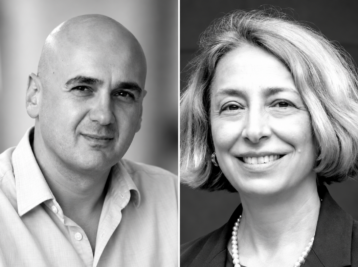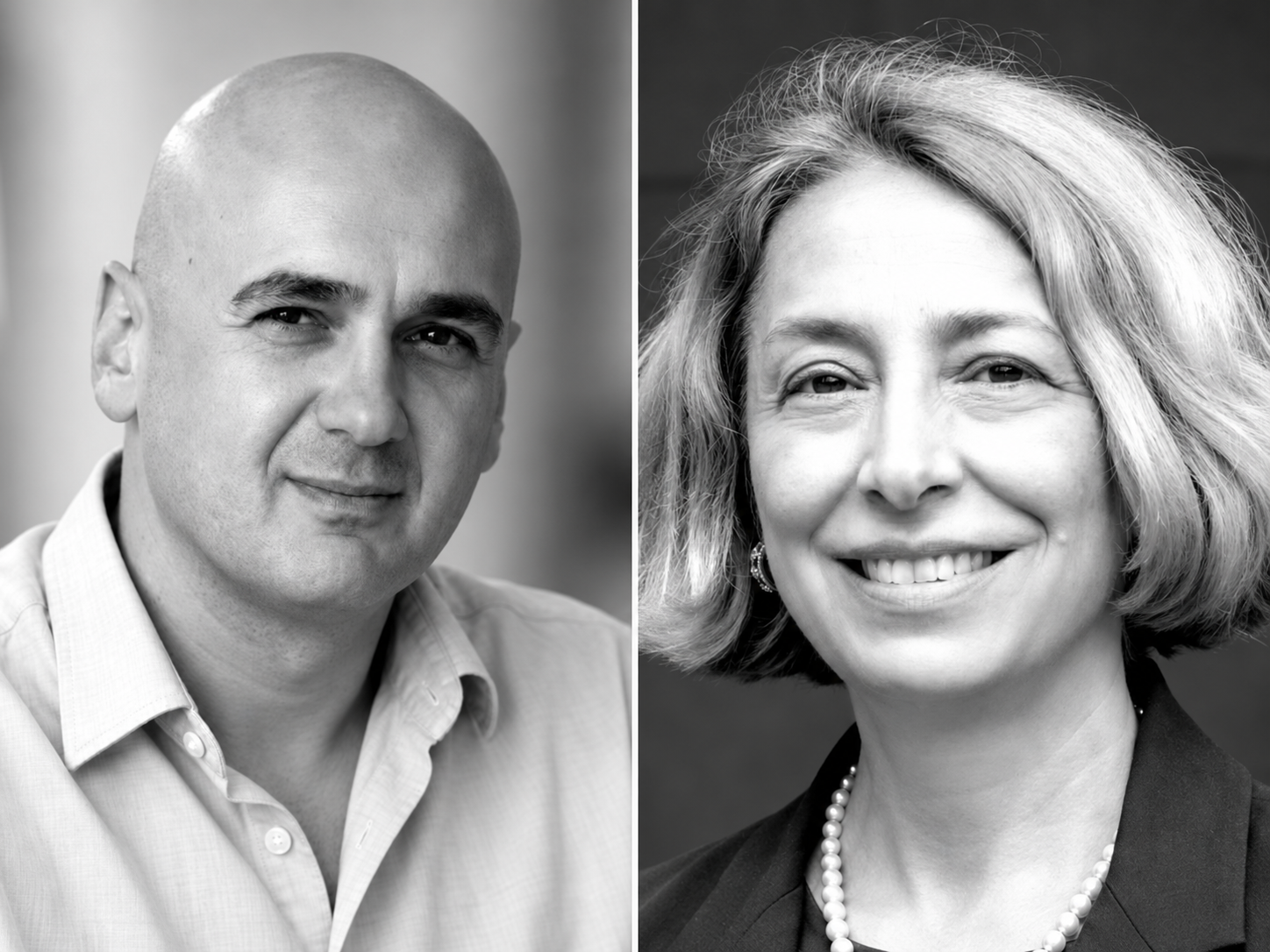
Following our conversation with Peter Hyttel and Bledion Baraliu, Chairs of the Digitalisation Work Group, our series on the renewed ACE Work Groups continues with Dubravko Bačić and Oya Atalay Franck, Chairs of the Education Work Group.
Od štúdia architektúry a odborných skúseností pod dohľadom až po celoživotné vzdelávanie a uznávanie kvalifikácií sa program skupiny zaoberá tým, ako sa architekti pripravujú na prax a rozvíjajú svoje kompetencie počas celej svojej kariéry.
In this interview, Dubravko and Oya share their professional backgrounds, outline their priorities for the next two years and discuss how education and practice can respond to changing environmental, technological and societal needs. They also explain why the experience and active involvement of ACE Member Organisations will be essential to the group’s work.
ACE: Mohli by ste sa stručne predstaviť a povedať nám o svojom profesionálnom zázemí?
Dubravko Bačić: I am a practising architect and Associate Professor at the Faculty of Architecture, University of Zagreb, where my work combines teaching, research and professional practice. I studied architecture in Zagreb, completed a Master in Design Studies in architectural history and theory at Harvard’s GSD, and later earned my doctorate in Zagreb. Alongside my academic work, I maintain a small practice, particularly in heritage conservation and adaptive reuse.
My involvement in ACE began in 2012, representing the Croatian Chamber of Architects. I served on the Executive Board for ten years, across five terms in 2014–2019 and 2022–2025, and led the ACE Schools Programme. At different stages, I also coordinated Access to the Profession, Professional Practice and Research & Development. These responsibilities have given me a perspective that connects how architects are educated with the regulatory, organisational and economic conditions in which they work.
Oya Atalay Franck: I am an architect, architectural historian and educator, and Dean of the School of Architecture, Design and Civil Engineering at ZHAW Zurich University of Applied Sciences in Winterthur, Switzerland.
From 2017 to 2024, I served as President of the European Association for Architectural Education (EAAE). My work brings together teaching, research, academic leadership and international collaboration. I also contribute to peer reviews and accreditation and serve on juries evaluating professional and student projects.
I am guided by the conviction that the quality of the built environment must be central to architectural education and professional practice. This means cultivating informed judgement, creativity and responsibility towards society and the environment.
ACE: What motivated you to become chair of this Work Group, and what are you most looking forward to contributing?
Dubravko Bačić: For me, co-chairing this Work Group is a continuation of a long-standing commitment rather than a new departure. Through the Schools Programme and ACE’s cooperation with EAAE, I have worked to bring education and professional preparation into our wider policy discussions. Co-organising the joint ACE–EAAE conference on upskilling in Brussels in 2023 was an important part of that effort.
We should also recognise how much cooperation already exists: EAAE’s 2025 sector study documents substantial involvement of external practising architects in studio teaching among the schools surveyed. The challenge, in my view, is to build on these connections through sustained joint work on professional preparation, research and continuing education.
What I hope to contribute is experience of working across ACE’s policy areas and understanding how common positions are developed from different national perspectives. Working alongside Oya, I would like to help translate shared ambitions into proposals that Member Organisations can use, while keeping the needs of both emerging architects and established practices in view.
Oya Atalay Franck: My motivation is to bring architectural education and the profession into closer dialogue. I see education as a continuous process, from university studies through practical experience to learning throughout a career. These stages have different purposes, but they should support one another.
I bring experience in architectural education and academic leadership at European level. Together with my Co-Chair, Dubravko Bačić, I look forward to working with representatives of ACE Member Organisations to identify shared concerns and learn from different national approaches.
For me, this exchange must work in both directions: education needs to engage with the realities of practice, while practice should benefit from the research, experimentation and critical reflection taking place in schools. We should prepare architects not only to respond to existing demands, but also to question them and help shape what comes next.
ACE: What are the Work Group’s main priorities for the next two years? What impact do you hope its work will have on ACE Member Organisations and the wider architectural profession?
Dubravko Bačić: Promoting the highest standards of architectural education and strengthening the shared basis of professional competence should guide all our work. The eleven areas of knowledge, skills and competences set out in Article 46 of the Professional Qualifications Directive (PQD) provide an essential common foundation, but European minimum requirements should not become a ceiling for educational ambition. In contributing to the Directive’s evaluation and possible revision, we should examine how these requirements are interpreted and applied across Europe, and how they might be strengthened to reflect the evolving responsibilities of architects. The objective should be to advance educational quality while reinforcing the mutual confidence on which professional recognition and mobility depend.
An immediate priority is the EU Skills Portability Initiative, which combines digital qualifications, a proposed revision of the Professional Qualifications Directive and new arrangements for recognising qualifications obtained outside the EU. We should support simpler, faster procedures while distinguishing administrative simplification from the standards required for independent practice. In examining the new recognition arrangements, I would focus on how equivalence is assessed, whether architectural training requirements are consistently safeguarded and how the profession and competent authorities contribute to those assessments.
Alongside this, we should continue to advance ACE’s 5+2 model: five years of architectural education followed by two years of supervised Professional Practice Experience (PPE). The essential distinction is between completing an academic programme and being ready to assume independent professional responsibility. PPE must offer meaningful supervision, clear learning outcomes, fair remuneration and experience of the different stages of a project, rather than simply record time spent in an office.
For Continuing Professional Development (CPD), we should strengthen its standing as a professional obligation while looking beyond the accumulation of hours or credits. Its value depends on the quality and relevance of the learning, including professional judgement, contracts, procurement, financial literacy and the organisation of practice, as well as new technical knowledge.
We will pursue these priorities in close collaboration with other ACE Work Groups, under the guidance of the Executive Board and with the support of the ACE Secretariat. For Member Organisations, the outcome should be stronger arguments for national advocacy and practical guidance on the recognition reforms. We should also help competent authorities prepare for new digital procedures and shorter deadlines, recognising that effective implementation requires adequate expertise and capacity.
Oya Atalay Franck: Our work focuses on three connected areas: the Professional Qualifications Directive (PQD), Professional Practice Experience (PPE) and Continuing Professional Development (CPD). Together, they address how architects qualify, enter the profession and maintain and develop their competence throughout their careers.
We will contribute to ACE’s position on the evaluation and future development of the PQD. This includes advancing ACE’s call for five years of architectural studies plus two years of practical experience, and addressing recognition difficulties when academic and professional qualifications are obtained in different countries. The objective is to support professional mobility while maintaining high standards.
For PPE, we want to compare national approaches and examine the quality and structure of the transition from study to professional practice. For CPD, the priority is to strengthen lifelong learning as a professional responsibility, supported by access to relevant, high-quality education.
Our first step is to review existing material and draw on members’ experience to identify where common action is needed. This includes examining how regional, national and European policies shape education and practice, and using these findings to inform ACE’s advocacy. We aim to develop practical recommendations that strengthen professional competence and help improve the quality of the built environment, while respecting the diversity of Europe’s educational and professional systems.
ACE: What do you see as the biggest challenge or opportunity in this area for architects across Europe? What developments should architects and practices prepare for, and how can the profession respond?
Dubravko Bačić: I would highlight the profession’s capacity to absorb change, not only the changes themselves. The 2024 ACE Sector Study reports that more than two-thirds of architectural practices are one-person businesses. This is an important starting point for any discussion of upskilling: a sole practitioner cannot organise learning or invest in new capabilities in the same way as a large office with dedicated staff and resources.
The skills-portability proposals could also make cross-border work and recruitment more accessible, particularly to practices without dedicated administrative support. But a digital record of an academic qualification is not, in itself, proof of entitlement to practice, and easier recognition does not remove the need to understand local building rules, contractual responsibilities and professional liability. I see a useful role for Member Organisations here: helping architects navigate these distinctions and supporting their preparation for work in another country.
The risk, as I see it, is that rising expectations widen the gap between practices with access to knowledge and support and those struggling to keep pace. Preparing for low-carbon construction, the transformation of existing buildings and digital workflows therefore also means addressing the time, cost and accessibility of professional learning. For practices, this calls for making skills development part of business planning, rather than treating it as something to fit in when a project ends.
My experience coordinating ACE’s Research & Development area has strengthened my interest in making European research more useful to everyday practice. ACE’s EU-funded projects offer a valuable basis for this. We should make greater use of their findings in case-based CPD, practical guidance and cooperation between schools and offices, so that access to innovation is not limited to those directly involved in research projects.
Oya Atalay Franck: I see the central challenge as developing our knowledge and skills while maintaining the architect’s capacity to bring technical, environmental, cultural and social considerations together. Climate adaptation, the transformation of existing buildings, circular construction and digitalisation all require this breadth of judgement.
Artificial intelligence makes the issue particularly clear: learning to operate a tool is not the same as understanding its assumptions, recognising its limitations or judging the quality of its results. Architects should engage with these technologies critically, creatively and ethically, while remaining responsible for their decisions. Equally, resource-conscious design should connect knowledge of materials, energy and construction with the spatial and social qualities of the places we create or transform.
The opportunity is to connect learning more closely with everyday practice. This means making time for continuing education and mentoring, and building closer links with schools and research institutions. The aim is to translate new knowledge into better decisions—not simply to accumulate additional technical skills.
ACE: What message would you like to share with ACE Member Organisations? How can members contribute to the Work Group’s activities, and why is their engagement important?
Dubravko Bačić: I would encourage Member Organisations to treat this Work Group as a place to shape policy, not simply to receive information about it. One lesson I take from my years on the Executive Board is that ACE is most effective when MOs and delegates help define the problem early, before a position has taken its final form.
A useful contribution need not be a comprehensive national report. A well-documented example of effective supervision, a difficulty encountered on the route to registration or a CPD programme that genuinely works for small practices can be equally valuable. What matters is explaining the conditions behind it and what others might learn from it.
I would particularly welcome contributions informed by young architects and the offices that employ and supervise them, alongside those of educators and competent authorities. Their experience can help us test whether a proposed requirement actually develops competence and whether the necessary support is available. Participation should give members something they can use in return: stronger arguments, useful comparisons and practical ideas for improving their own systems.
Oya Atalay Franck: Education is a shared professional responsibility. I encourage Member Organisations to bring both their experience and their questions to the Work Group.
National regulations, position papers, examples of practical training and CPD, and specific difficulties encountered by architects all provide valuable starting points. Members can share these through our common repository and help develop recommendations. We ask participants to focus their contribution on one of the three topics, while remaining part of the wider exchange.
This engagement is essential because credible European positions must be grounded in national realities. We need to understand both what works and where obstacles remain. This will help us identify where a common approach is useful and where different contexts call for different responses.
About the Co-Chairs
Dubravko Bačić
Dubravko Bačić is a practising architect and Associate Professor at the Faculty of Architecture, University of Zagreb. Educated in Zagreb and at Harvard’s Graduate School of Design, he holds a doctorate in architecture, with a research focus on contemporary architectural education. His work combines teaching and research with architectural practice, particularly heritage conservation and adaptive reuse. Active in the Architects’ Council of Europe since 2012, he served ten years on its Executive Board, led its Schools Programme, and coordinated Access to the Profession, Professional Practice and Research & Development. Currently, he is Co-Chair of the ACE Education Work Group.
Oya Atalay Franck
Oya Atalay Franck is an architect, architectural historian and educator. She is the Dean of the School of Architecture, Design and Civil Engineering at ZHAW Zurich University of Applied Sciences in Winterthur, Switzerland. She served as President of the European Association for Architectural Education (EAAE) from 2017 to 2024.
Her work encompasses teaching, research, academic leadership and international collaboration. She contributes her expertise to peer reviews and the accreditation of higher education institutions and serves on juries evaluating professional and student architectural projects.
She places the quality of the built environment—and its contribution to people’s lives—at the heart of architectural education and professional practice.