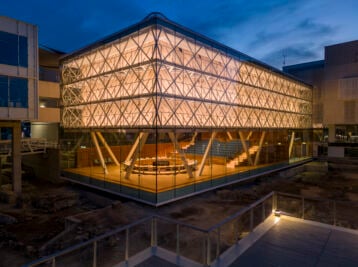
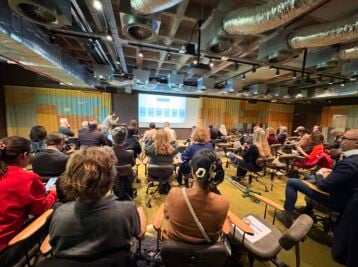
In the face of a transformative era for the European Union’s built environment, the Architects’ Council of Europe and Europa Nostra convened a one-day public conference ‘New European Bauhaus: Heritage & Transformation’ on 28 November 2024 in Krakow, Poland. The event aimed to engage policymakers and stakeholders in discussions about the challenges surrounding built heritage. The program highlighted best practices, innovative solutions for preservation, retrofitting, and adaptive reuse, as well as the barriers and enablers necessary to scale these efforts and foster innovation.
Konferencen tiltrak omkring 250 deltagere både onsite og online.
Opening session
After welcoming the participants, moderators Agata Wąsowska-Pawlik, Director of the International Cultural Centre (ICC) and Board Member of Europa Nostra, and Borys Czarakcziew, Board Member of the Architects’ Council of Europe, invited the representatives of the host organisations to make the introductory remarks. Ruth Schagemann, President of the Architects’ Council of Europe, and Sneška Quaedvlieg-Mihailović, Secretary General of Europa Nostra and Project Leader of the European Heritage Hub, set the tone for the conference by underlining the importance of partnerships within civil society and with other stakeholders.

Senator Jerzy Fedorowicz, Chairman of the Committee on Culture and the Media of the Polish Senate, Janusz Sepioł, Chief Architect of the City of Kraków, and Bogdan Andrzej Zdrojewski, Member of the European Parliament, Vice-Chair of the Committee on Culture and Education, addressed the audience. “The New European Bauhaus shows that the European Green Deal cannot be created in a fragmented way. It is a platform for unleashing creativity and cooperation between culture and science”, stated Bogdan Andrzej Zdrojewski in a video message broadcast from the conference.
Prof. Jacek Purchla, Vice-President of Europa Nostra and Chair of the European Heritage Awards / Europa Nostra Awards Jury, delivered a keynote on the history and significance of the inscription of the Historic Centre of Kraków on UNESCO’s World Heritage List, highlighting the city’s experience in terms of heritage and development. “Kraków belongs to those cities where heritage is decisive,” he said, also mentioning the urban heritage keystones of liveability: quality, identity, environment, management, participation and economy.
The New European Bauhaus and cultural heritage
The first panel discussion focused on the New European Bauhaus and cultural heritage, featuring Pia Maier Schriever, Member of the NEB High Level Round Table, Ștefan Bâlici, President of the Romanian Order of Architects, and Marcos Ros Sempere, Member of the European Parliament.
Exchanges revolved around the importance of co-creating our built environment, making housing more sustainable and affordable, and recognising heritage as a resource of knowledge and innovation. Stefan Balici highlighted that to achieve its ambitious objectives for Europe’s built environment, the New European Bauhaus ought to be mainstreamed as a quality framework, as advocated in the Bucharest Manifesto “For Quality-Driven Cultural Heritage Practice in Europe” recently published by Europa Nostra.

Innovation for cultural heritage
The second panel conversation on Innovation for cultural heritage included presentations by Diego Zoppi, ACE Board Member, Coordinator of the thematic Area ‘Practice of the Profession’, and Prof. Jerzy Hausner, Founder and Chairman of the Open Eyes Economy Summit, who focused on the regenerative power of culture to move from a conventional to a regenerative economy.
"Cultural regeneration takes place through multigenerational local cultural practices. In this case regeneration means forming new imaginaries. If we don’t treat people as curators but as users, we are creating non-places in which to live,” said Prof. Jerzy Hausner.
Sustainability in the context of heritage
The afternoon session continued with a roundtable on Sustainability in the context of heritage, reflecting on the impacts of climate change on our built environment and solutions for protection, retrofit, re-use and risk preparedness. Panellists Carl Bäckstrand, partner and deputy CEO of White Arkitekter and Vice-President of ACE, Prof. Stefano Musso, Chair of the ACE Heritage Working Group, Riin Alatalu, ICOMOS Vice-President for Europe, and Graham Bell, Board Member of Europa Nostra, highlighted the shift in policies from demolition to retrofitting of existing buildings, but noted that traditional skills and knowledge are still overlooked.
Education and public participation
The following panel on education and public participation featured presentations by two winners of the European Heritage Awards / Europa Nostra Awards 2024: Saxon Church in Alma Vii, Romania, Grand Prix in the Category ‘Conservation and Adaptive Reuse’, and Public Choice Award (by Stefan Balici, President of the Romanian Order of Architects), and Boulouki – Travelling Workshop on Traditional Building, Greece, laureate in the Category ‘Education, Training and Skills’ (by Ionas Sklavounos, Co-founder and Project Manager), who both emphasised the value of public participation, cultural heritage not being an end but a tool for the community.
Piotr Lewicki from Łatak-Lewicki Architectural offices talked about the redevelopment of the Cracovia Hotel, demolition of which was prevented thanks to a citizens’ movement. It will now be transformed into an architecture and design museum. Olaf Grawert, Campaign Manager at HouseEurope!, explained this European citizens’ initiative for renovation combining practice, research and policy.
Heritage and recovery
The last panel discussion delved into the topic of heritage and recovery, drawing from the lessons of the war in Ukraine.
Prof. Bohdan Cherkes, Director of the Institute of Architecture at Lviv Polytechnic University, argued that European cities should be prepared for shelling in today’s aggressive context and that specialists should be trained to save cultural heritage in the extreme conditions of wartime.
Ruta Leitanaite, Board member of the Architects Association of Lithuania, and Coordinator of the Creative Europe project “UREHERIT”, announced the just published Recommendations from the European Commission-led expert group on the safeguarding of cultural heritage in Ukraine, recognising heritage as a key resource for recovery.
Finally, Akrivi-Athina Vlachou, Urban Specialist at the European Investment Bank (EIB), presented the NEB Investment Guidelines, a tool providing practical and procedural aspects of investment and project preparation in the built environment aligned with NEB values.

Closing session and Kraków Declaration
Konferencen sluttede med en forsmag på Krakowerklæringen "Nyt europæisk Bauhaus: Heritage & Transformation", udstedt i fællesskab af ACE, Europa Nostra og ICOMOS, hvori der fremsættes 7 centrale anbefalinger vedrørende fremtiden for Europas bebyggede miljø, lige fra fremme af renovering og tilpasningsdygtig genbrug, inddragelse af innovation og traditionel viden, opkvalificering og borgerdeltagelse til kvalitetskriterier, peerlæring og risikostyring og -beredskab.
"Med Kraków-erklæringen ønsker vi at skabe et formål med de politiske rammer. Arkitektur og byplanlægning er en afspejling af vores samfund. Det handler om at skabe værdi og stille de rigtige spørgsmål. Det handler om mennesker, kvalitet og frihed til at vælge, hvor de vil bo, i byområder eller landdistrikter." sagde han Ruth Schagemann, formand for Europarådets arkitektråd.
Erklæringen foreslår også en Opfordring til handling til den nye Europa-Kommission, nyligt valgte medlemmer af Europa-Parlamentet og medlemsstaterne. "EU bør anlægge en holistisk, kvalitetsbaseret og kulturel tilgang i alle EU's politikker og finansieringsprogrammer, der har indvirkning på den byggede kulturarv. Vi vil nå ud til relevante medlemmer af det nye kommissærkollegium med ansvar for bl.a. samhørighed, boliger og færdigheder,” anførte Sneška Quaedvlieg-Mihailovic, generalsekretær for Europa Nostra og projektleder for det europæiske kulturarvscenter.
This hybrid event was organised in collaboration and with the support of the International Cultural Centre and the Europa Nostra Heritage Hub in Krakow, in the framework of the EU-funded European Heritage Hub pilot project. This event is co-funded by the Creative Europe programme of the European Union and has received the Honorary patronage of the Mayor of Kraków, Aleksander Miszalski.
Read the speakers’ biographies.
Presentation of speakers are available on dropbox.
Watch the conference on ACE youtube channel
With the support of:

Photos: Paweł Mazur, Copyrights International Cultural Centre in Krakow
ACE General Assembly
On 29 November, the ACE held its General Assembly in Krakow, bringing together over 100 delegates from across Europe. The assembly serves as a platform to discuss key issues impacting the architectural profession in Europe.

Photos: ACE 2024