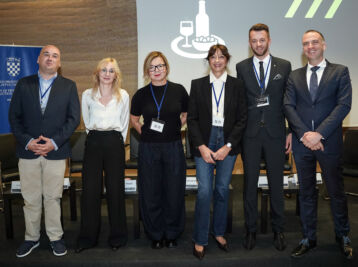
Zagreb, 20 October 2026. ACE Vice-President Elizabeth Gossart opened the international conference on the implementation of architectural policy in the digital age, alongside Deputy Prime Minister Branko Bačić. She then took part in the panel on implementing architectural policies at the local level.
The two-day conference was organised by the Ministry of Physical Planning, Construction and State Assets and its Institute for Physical Planning, with the Croatian Chamber of Architects and ESPON. It took place as Croatia presents the final draft of its new generation of architectural policies.
From ambition to everyday places
Elizabeth Gossart welcomed the draft as part of a wider European movement. ACE’s 2025 study on architectural policies identified 37 administrations with official policies at national or regional level. She also pointed to the policies recently adopted in Slovakia and being developed in Romania. “Different countries, different stages. But the same responsibility: to ensure that our policies improve the places where people live.”
Recalling a conviction that has guided ACE since 1990, she said that architecture “is not simply an economic activity. It is a political act and a responsibility towards society.” As a French architect, she cited the 1977 French Law on Architecture, which recognises architectural quality, landscapes and heritage as matters of public interest.
Quality, housing and the ecological transition
On affordable housing, her message was clear: “Quality is not something you add on once everything else has been paid for. Quality is part of the project.” Good design supports affordability over a building’s whole life, from energy bills to maintenance and adaptability. She also argued that the ecological transition is a question of design, not only of technical standards: “How can we transform rather than demolish? How can we build with the climate rather than against it?”
Competitions: giving quality a chance
She stressed the role of public clients, starting before any call for tenders, with a sound brief, a suitable procedure and clear quality criteria. She described design competitions as “a way of seeking the best answer to a complex question” that also opens commissions to young teams and small practices. She referred to ACE’s Recommendations for Architectural Design Contests as a practical framework.
Digital tools serve human judgement
Turning to the conference’s digital theme, she welcomed digital twins, data and AI as tools to test options and engage citizens, with a caution: “Technology must enhance our ability to design. It must not reduce our responsibility to design. The choice must remain with people.”
Panel: from national policy to the mayor’s desk

In the panel moderated by Bojan Linardić, Elizabeth Gossart discussed how France translates architectural policy into practical support for local authorities and citizens. She focused on the complementary roles of the Councils for Architecture, Urban Planning and the Environment (CAUE) and the Architectes des Bâtiments de France (ABF), which assist small municipalities and individuals with their projects.
Established under the 1977 French Law on Architecture, the CAUE serve the public interest by providing advice on architecture, urban planning and the environment. Gossart illustrated the discussion with projects ranging from a village of 68 inhabitants to central Paris, showing the relevance of architectural quality across very different local contexts.
She joined:
- Assoc. Prof. Dubravko Bačić, Chair of the ACE Work Group on Education, Faculty of Architecture, University of Zagreb;
- Luka Korlaet, Deputy Mayor of Zagreb;
- Galena Grohovac (Rovinj);
- Božo Benić (Dubrovnik).
Contributions from Zagreb, Rovinj and Dubrovnik brought perspectives from towns and cities of different sizes, exploring how legislation supporting architectural and urban quality can help shape local projects.
The panel also returned to design competitions and the involvement of the people concerned with a future building. Elizabeth Gossart highlighted the French experience of involving building users from the earliest stages, including the preparation of the brief before a competition, and maintaining their involvement as the project develops. This continuity helps ensure that the completed building meets users’ needs and operates effectively.
The discussion connected national policy with the practical conditions for delivery: access to professional advice, the capacity of local planning teams, well-prepared competitions and meaningful stakeholder participation.
ACE Vice-President concluded her opening address with these words: “Architecture is not simply what we build. Architecture is what we pass on.”
Videos and photos from the conference will be available on the organisers’ website.
Photos: © Republic of Croatia – Ministry of Physical Planning, Construction and State Assets / Institute for Spatial Development